
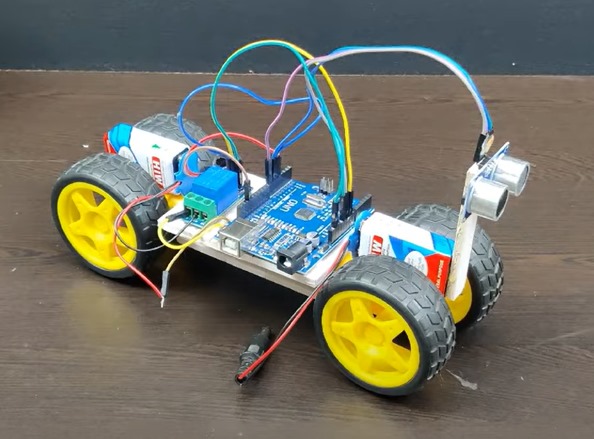
Autonomous Mini Car For Ultrasonic Collision Avoidance
Arduino-Based Mini Vehicle That Senses Obstacles And Automatically Stops Or Steers To Avoid Collisions.
About This Project
Tech
Arduino Nano, Ultrasonic Sensor (HC-SR04), Motor Driver (L298N/L9110S), DC Gear Motors, PWM, State Machine
Abstract
This mini project presents an Arduino Nano-controlled collision-avoidance vehicle that uses an ultrasonic sensor to perceive obstacles and autonomously mitigate crash risk. The sensor samples distance ahead, filtered through a moving-average or median approach to reduce noise, and feeds a finite state machine with three modes: Cruise, Caution, and Stop. In Cruise, motors run at a set PWM duty; in Caution, speed is reduced and alerts are issued; in Stop, the vehicle brakes and holds until the path is clear. A standard H-bridge driver controls the DC motors, while a compact Li-ion battery pack powers logic and actuators through a regulated rail. The design focuses on simplicity, low part count, and easy calibration of safe-distance thresholds. Optional features include a servo-mounted sensor for basic scanning and an audible indicator for user feedback. The result is a practical demonstration of autonomous safety behavior in a small, low-speed platform.
Keywords
Ultrasonic sensor, Arduino Nano, Collision avoidance, Autonomous vehicle, State machine, Embedded system, PWM control, H-bridge, Obstacle detection, Educational robotics
Project Information
Hardware: Arduino Nano (or compatible), HC-SR04 ultrasonic sensor, L298N/L9110S motor driver, two DC gear motors with wheels, caster wheel, mini chassis, Li-ion battery pack with protection (BMS) and 5V regulator, switch, LEDs/buzzer, and basic wiring components. Software: Arduino IDE with simple state-machine logic. The ultrasonic module measures time-of-flight to compute distance; readings are debounced and filtered. A configurable safeDistance (e.g., 25–40 cm) governs transitions: above threshold → Cruise; near threshold → Caution (slow); below threshold → Stop. PWM pins regulate motor speed; enable pins handle braking. Basic diagnostics—blink patterns or beeps—communicate mode. Calibration involves measuring real stopping distance at different speeds and adjusting thresholds accordingly. Mechanical layout keeps the sensor front-center at ~5–7 cm height, angled slightly downward to avoid floor reflections. Safety includes reverse-polarity protection, fuse or polyfuse on battery output, and secure wire management to prevent shorts during movement.
Project Objective
The primary objective is to design and prototype a compact, autonomous collision-avoidance mini car that detects obstacles and reacts in real time to prevent impact. Using an ultrasonic sensor for distance measurement, the system should continuously monitor the path ahead, compute a safe stopping distance based on speed, and trigger braking or a controlled stop when objects are detected within a threshold. Secondary objectives include implementing a basic steering maneuver (optional short swerve) when space allows, integrating efficient power management for stable operation, and providing clear user feedback via LEDs or a buzzer. The project aims to demonstrate core embedded-systems concepts—sensor interfacing, signal filtering, PID-free speed handling via PWM, and simple state-machine logic—while remaining compact and reproducible. Emphasis is placed on reliability, modular wiring, and documented calibration steps so the build can be replicated by students and adapted to different miniature chassis or sensor placements.
Project Features
- Real-time ultrasonic distance measurement with noise filtering
- Three safety modes: Cruise, Caution, Stop
- Automatic braking using PWM ramp-down and active hold
- Optional servo sweep for simple left/right scanning
- Visual/audible alerts for user feedback
- Configurable safe distance and speed limits
- Compact, modular wiring and plug-and-play components
- Basic power protection (BMS/fuse) and regulated logic rail
- Simple state-machine firmware for clarity and reliability
- On-board calibration/test routine via button press
Specifications
- Hardware components: Arduino Nano, HC-SR04 sensor, L298N/L9110S motor driver, DC gear motors, chassis, Li-ion battery, BMS, 5V regulator, LEDs, buzzer
- Software components: Arduino IDE, embedded C++, State machine logic, PWM control
Project Application
- Educational demo for autonomous safety concepts
- Intro to sensor fusion and embedded control labs
- Prototype for warehouse toy robots avoiding collisions
- Campus robotics club obstacle-avoidance challenges
- STEM outreach exhibits demonstrating active safety
Project Advantages
- Simple, reproducible architecture with common parts
- Clear, observable safety states for learning
- Low power consumption and portable form factor
- Easily tunable thresholds for varied environments
- Expandable to multi-sensor setups without redesign
Project Limitation
- Ultrasonic blind spots on soft/angled surfaces
- Limited range and accuracy versus lidar/camera
- Performance degrades in noisy echoic environments
- No global planning; reacts only to immediate obstacles
- Basic steering logic; may stop rather than reroute
Future Scope
- Add side ultrasonic sensors or infrared for redundancy
- Implement servo-based scanning with obstacle-map heuristic
- Integrate Bluetooth app for live telemetry and tuning
- Upgrade to closed-loop speed control with encoders
- Explore simple SLAM with lidar or depth camera (later)
Conclusion
This mini project demonstrates a compact, effective approach to collision avoidance using readily available components and straightforward embedded logic. By pairing an Arduino Nano with an ultrasonic sensor and a standard H-bridge driver, the vehicle can sense obstacles, slow down, and stop before impact, illustrating the fundamentals behind active safety features. The modular design and state-machine firmware keep the build accessible to beginners while still showcasing good practices such as signal filtering, PWM-based speed management, and threshold calibration tied to actual stopping distance. Although limited by the inherent constraints of ultrasonic sensing and simple reactive behaviors, the platform provides a solid foundation for incremental enhancements, including multi-sensor fusion, scanning, and telemetry. Overall, it serves as a practical, educational prototype that highlights real-time perception and control, offering clear visual and audible feedback that makes autonomous safety behavior easy to understand, test, and extend.
Report Contents
- Components List (BOM: Bill of Material)
- Block Diagram
- Flow Chart
- Components : Name, Images, Details
- Circuit Diagram
- Problem Statement
- Abstract
- Introduction
- Methodology
- Challenges and Solutions
- Performance Analysis
- Advantages
- Limitation
- Application
- Future Scope
- Conclusion
- Output Images
Project Deliverables
- Project Hardware
- Project Report
- Project Simulation
Want this project or a custom version?
Contact us for complete project, documentation, source code, customization or deployment help.
Payment Policy
Simple two-step payment for every project
Step 1 · Advance
50%
of project cost at confirmation to reserve your slot and start work.
Step 2 · Handover
50%
of project cost on delivery of the complete project package.