
1 / 4
Smart Auto Door System Using Motion Detection
An Automatic Door Opening System Using Pir Sensor And Servo Motor For Contactless Access.
Project Gallery
5 files · click to zoom · download icon on each image

About This Project
Tech
PIR motion sensor, Arduino Nano, Servo motor, LEDs, Buzzer, jumper wires, cardboard model
Abstract
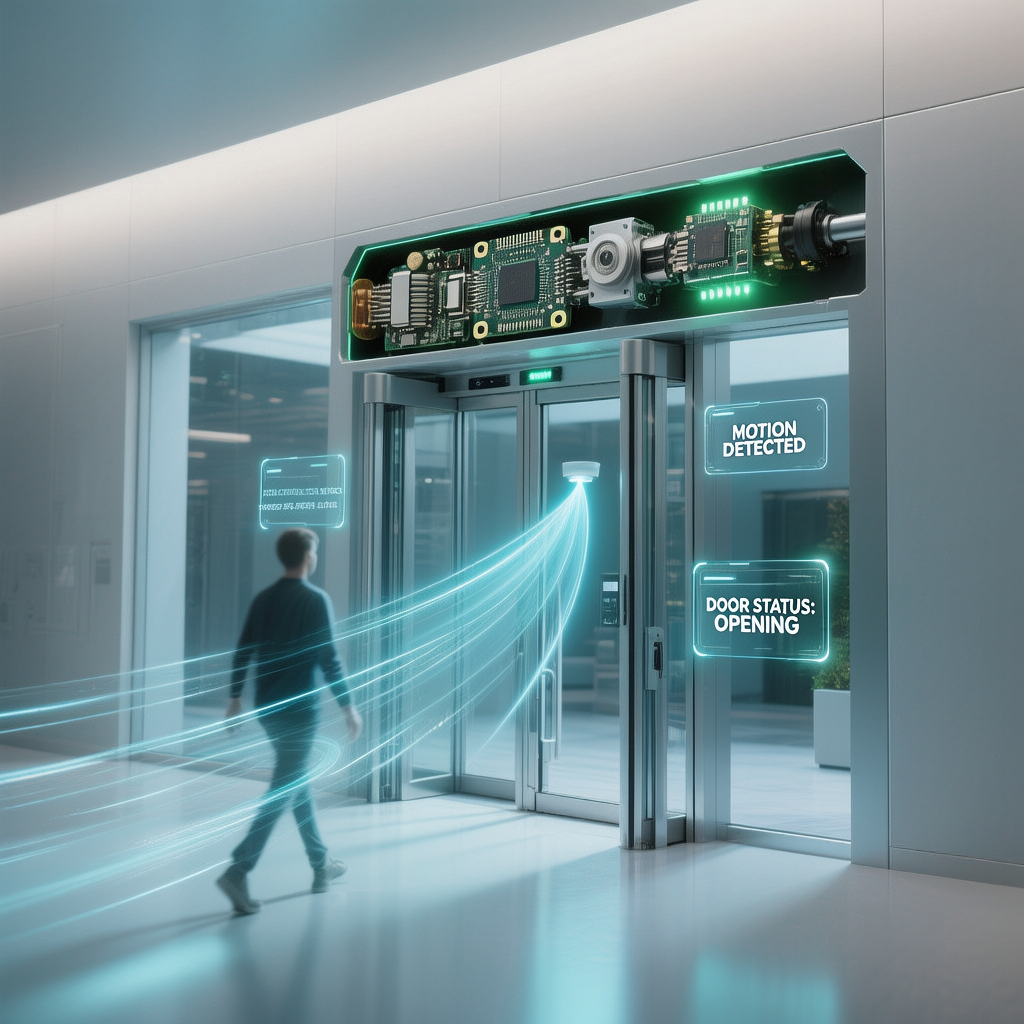
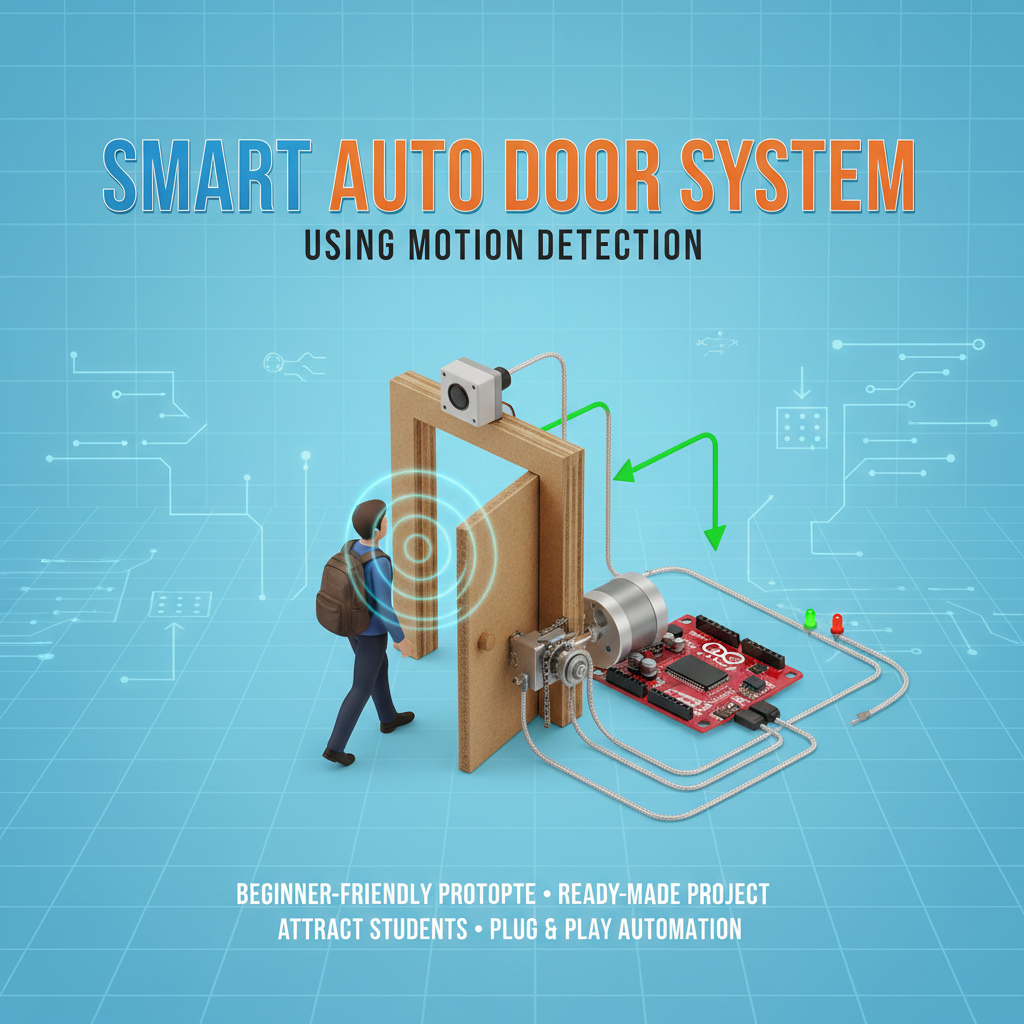
This project presents the design of an automatic door system that operates using motion detection. A Passive Infrared (PIR) sensor senses the presence of a person near the door and sends a signal to an Arduino Nano. The microcontroller processes the input and drives a servo motor to open or close a lightweight demonstration door. LEDs and a buzzer provide visual and audio status feedback to the user. The system prioritizes simplicity, low cost, and reliability, making it suitable for small-scale environments and educational demonstrations. By minimizing contact with door handles, the design improves hygiene and convenience in places such as hospitals, offices, malls, and homes. The project demonstrates key embedded-systems concepts: sensor interfacing, real-time signal processing, actuator control, and basic human–machine interaction. It is intended as a compact engineering mini-project that can be scaled or extended with more advanced components for practical deployments.
Keywords
PIR sensor, motion detection, Arduino Nano, servo motor, contactless entry, automation, LEDs, buzzer, embedded systems, prototype
Project Information
The Smart Auto Door System is an embedded electronics project demonstrating automatic door actuation using low-cost components. A PIR motion sensor detects infrared radiation from a human body and sends a trigger to the Arduino Nano. The Arduino runs a simple control routine to move a servo motor which opens a lightweight cardboard door model. LEDs indicate sensor state and door movement, while a buzzer gives audible confirmation. The design is intended for classroom demonstration or a small engineering showcase: it teaches wiring, microcontroller programming, timing control, and basic mechanical linkage. The prototype is powered from a regulated 5V supply and housed on a small demonstration frame. Although suited for lightweight doors, the concept can be adapted to stronger actuators and sensors for larger installations.
Project Objective
The objective is to design and implement a simple, reliable automatic door system that improves convenience, hygiene, and basic access control. Using a PIR motion sensor, the system detects human presence and triggers a servo motor to open the door without physical contact. Visual (LED) and audio (buzzer) feedback enhance user awareness. The project demonstrates practical application of low-cost sensors and microcontrollers for real-time automation, and provides hands-on learning in sensor integration, signal debouncing, timing, and actuator control. It aims to deliver a portable mini-project that students can build, test, and extend with additional features such as security or IoT connectivity.
Project Features
- Motion detection using PIR sensor
- Automatic door actuation with servo motor
- Visual feedback via LEDs
- Audio feedback via buzzer
- Contactless operation to improve hygiene
- Simple wiring and Arduino-based control
- Low-cost components for easy replication
- Lightweight cardboard demonstration model
- Basic timing and debounce logic to avoid false triggers
- Scalable concept for larger actuators
Project Application
- Touchless entry for hospital wards and clinics
- Automated doors for small retail or mall displays
- Smart home entry demonstrations
- Hands-free office access for convenience
- Hygienic restroom or pantry doors
- Educational demos in electronics workshops
- Prototype for product development and testing
- Public awareness displays on contactless tech
- Accessible entry aids for mobility-impaired users
- Integration testbed for IoT add-ons
Project Advantages
- Reduces physical contact, promoting hygiene
- Provides convenient, hands-free access
- Cost-effective and easy to build
- Good learning tool for embedded systems
- Modular and easy to extend
- Low power consumption for demo setups
- Quick assembly with off-the-shelf parts
- Portable for classroom presentations
- Covers core concepts: sensing, control, actuation
- Minimal maintenance for prototype
Project Limitation
- Limited detection range of PIR sensor
- Servo motor unsuitable for heavy real doors
- Requires continuous power supply for operation
- Possible false triggers from random movement
- Not weatherproof in current prototype form
- Cardboard model is for demonstration only
- No built-in security/authentication
- Delay tuning needed to avoid rapid toggling
- Environmental IR sources can affect sensor
- Scaling requires stronger actuators and mechanics
Future Scope
- Smartphone app or remote control integration
- Fingerprint, RFID, or keypad-based secure access
- Use of DC gear motors for real door mechanisms
- Solar-powered or battery-backed operation
- IoT connectivity for monitoring and analytics
- Weatherproofing for outdoor deployment
- Machine-learning-based presence detection
- Integration with building automation systems
- Energy-optimised standby and wake modes
- Fail-safe mechanisms and manual override options
Conclusion
The Smart Auto Door System using PIR motion detection is a compact and practical mini-project that demonstrates essential automation and embedded systems concepts. By combining a PIR sensor, an Arduino Nano, and a servo motor, the prototype achieves contactless door operation that improves hygiene and user convenience. The project is designed for simplicity and cost-effectiveness, making it suitable for students and hobbyists as a demonstration model or a starting point for further development. While the current prototype is best for lightweight doors and educational settings, the underlying concept can be expanded to include secure access control, IoT connectivity, and more robust actuators for real-world deployment. Overall, this mini-project offers a hands-on learning experience and a clear pathway for incremental improvements toward practical automated door solutions.
Report Contents
- Components List (BOM: Bill of Material)
- Block Diagram
- Components: Name, Images, Details
- Circuit Diagram
- Problem Statement
- Abstract
- Introduction
- Challenges and Solutions
- Advantages
- Limitation
- Application
- Future Scope
- Conclusion
- Output Images
Project Deliverables
- Project Hardware
- Project Report
- Project Simulation OR Demo Video
Want this project or a custom version?
Contact us for complete project, documentation, source code, customization or deployment help.
Payment Policy
Simple two-step payment for every project
Step 1 · Advance
50%
of project cost at confirmation to reserve your slot and start work.
Step 2 · Handover
50%
of project cost on delivery of the complete project package.